People
Faces of the day
A few lives, in rotation. Scroll a little and the portrait changes whole: image and words together, never half of one person stacked on half of another. One flick of the wheel is one face; then the page holds until you scroll again. Writers, painters, and musicians share this shelf. The faces change with the day; the stories stay.
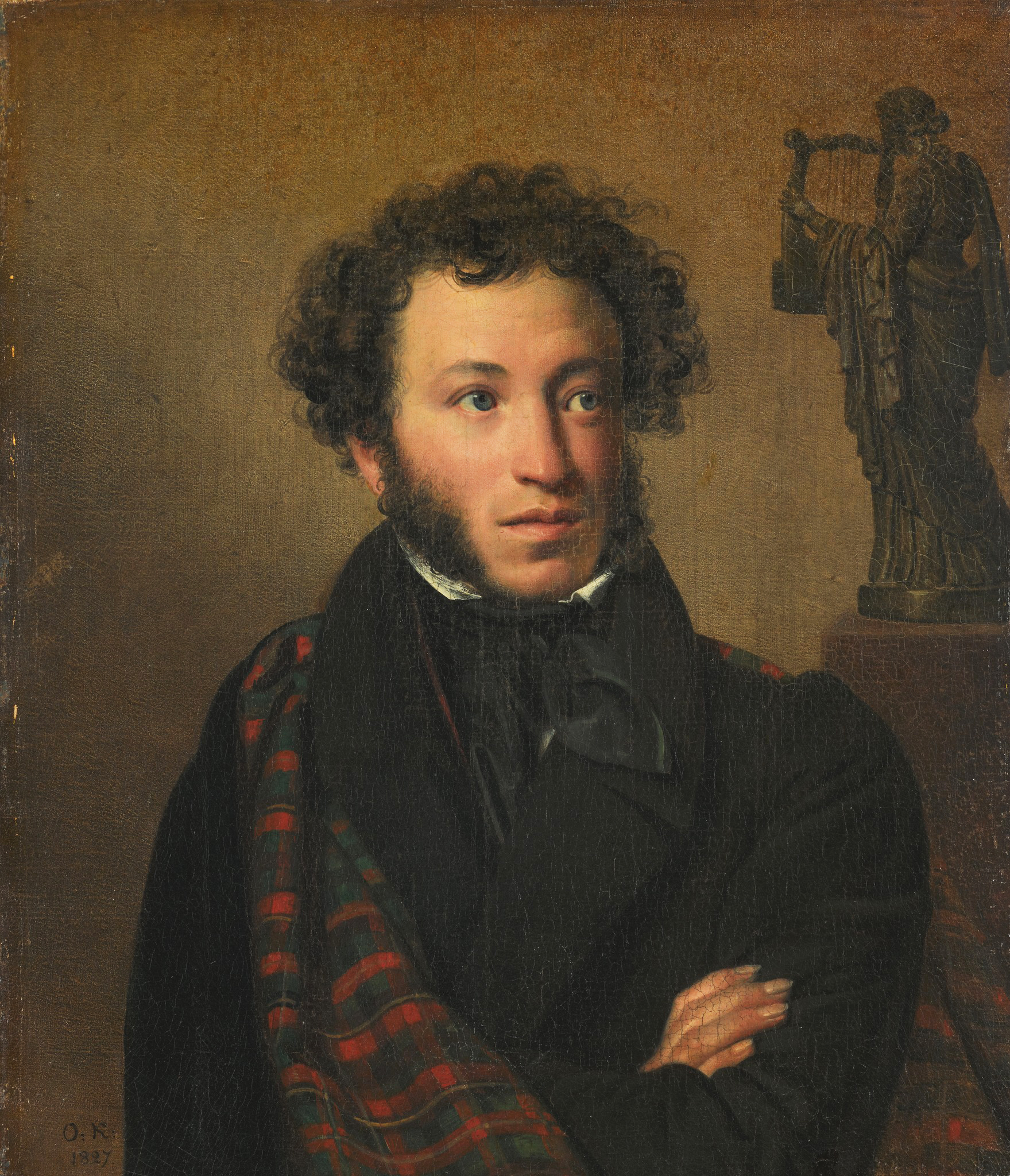
Poet1799–1837
Alexander Pushkin
Александр Пушкин
The poet Russians treat as the beginning of their literary language.
He died at thirty-seven after a duel, having already written a novel in verse, a bronze city, and lyrics that still sound like speech. Later prose — Turgenev, Tolstoy, the rest — writes in a Russian he made flexible enough for ordinary life. If you read only one work, let it be Eugene Onegin.
Read the storyЯ к вам пишу — чего же боле? Что я могу ещё сказать?
I write to you — what more is needed? What else is there that I could say?
1 / 3
Skip to the storiesThe stories
Writers
The faces above change with the day. These pages stay. Each asks for a sitting of about a quarter of an hour: not a life in dates, but the work itself, with pictures and lines from the books.
people
Who Was Pushkin?
Why one poet sits at the centre of Russian literary language.
14 min read
people
Gogol’s Laugh
From a beekeeper’s tales to Dead Souls: how a comic genius taught Russian prose to look at a clerk, a town, and a road.
14 min read
people
Who Was Lermontov?
A short life, a Caucasian exile, and the novel that made boredom look like a generation’s portrait.
13 min read
people
What Chekhov Left Unsaid
The doctor who taught the short story and the stage to refuse a neat ending.
14 min read
people
How to Start Reading Dostoevsky
From the underground to the Karamazovs: novels in which an idea is tested on a human life.
14 min read
people
Why Tolstoy Still Matters
Yasnaya Polyana, two vast novels, and a late life that tried to judge the art that made him.
15 min read
people
Turgenev’s Terrace
The novelist who named nihilism for a generation, then wrote Russia from a house near Paris.
13 min read
Painters
The same sitting, with more canvas: seas, fields, and a landscape that has a mood. Not a museum wall. A way of looking until the picture looks back.
people
Aivazovsky’s Water
The Crimean painter who made the sea a character, not a backdrop.
13 min read
people
Levitan’s Mood
The landscape that feels like a thought — a path, a thaw, a lake too large for the church.
14 min read
people
Shishkin’s Forest
The painter who walked into the woods — rye, pine, oak — and made looking a kind of epic.
13 min read
people
Repin’s Rooms
The painter who put a country in a doorway — barge-haulers, a tsar, an exile, a dying composer.
14 min read
people
Vasnetsov’s Reverie
The painter who sat on a stove listening to fairy tales, then made bogatyrs a national face.
14 min read
Musicians
The same sitting, with sound: a few minutes of the work itself, cut to the passage that made a reputation, beside the pictures and the sentences that explain why it still carries.
people
Tchaikovsky’s Theatre
The composer who made a lake, a celesta, and a festival overture into the world’s idea of Russian sound.
14 min read
people
Mussorgsky’s Walk
The composer who made a dying friend’s pictures into a city of sound — and a tsar’s doubt into speech.
13 min read
people
Rimsky’s Colour
The naval officer who taught Russian music to gleam: a storyteller’s sea, a bee’s flight, an Easter morning.
14 min read